Shop by category
Shop by goal
Build your own test
Pick from 90+ biomarkers and create a panel tailored to your goals.
Start buildingPick from 90+ biomarkers and create a panel tailored to your goals.
Start buildingSix-marker female hormone panel covering oestradiol, progesterone, LH, FSH, testosterone, and SHBG for cycle health and hormonal balance.
or 4 interest-free payments of £19.75 with Klarna
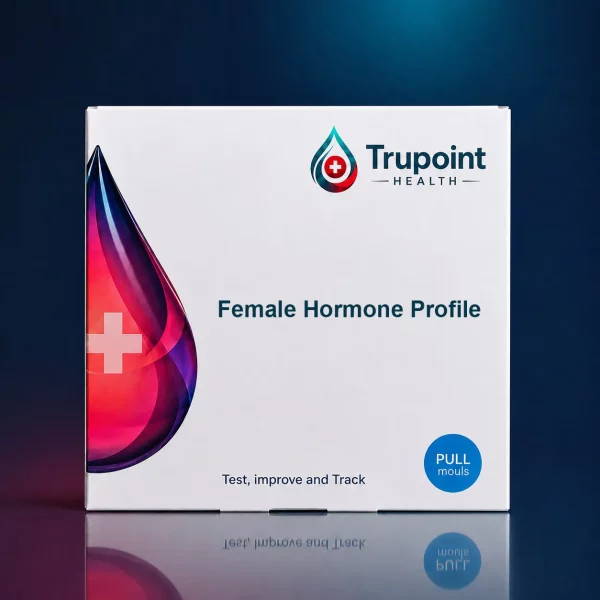
A six-marker hormone panel measuring oestradiol, progesterone, LH, FSH, testosterone, and SHBG.
Hormones influence energy, mood, libido, skin, weight, bone density, and reproductive health. The Female Hormone Profile provides a concise overview of the key sex hormones that govern a woman’s monthly cycle and broader wellbeing.
Oestradiol and progesterone reflect ovarian function and cycle phase. LH and FSH are the pituitary signals that drive ovulation — their levels relative to each other help identify cycle irregularities and flag the approach of perimenopause. Testosterone and SHBG assess the balance of androgenic hormones, which influence energy, libido, and body composition.
This panel is suitable for baseline assessment and annual monitoring. For deeper fertility or perimenopause investigation, our extended hormone panels include additional markers such as AMH, prolactin, and DHEAS. Venous blood draw required; book a mobile phlebotomist or partner clinic appointment. GMC-physician reviewed results within 3 to 5 working days.
Understand what each marker measures, why it matters, and what the science says — not just a list of numbers.
Primary oestrogen produced by the ovaries; regulates the menstrual cycle, bone density, cardiovascular health, and mood.
Learn more about Oestradiol (E2)Post-ovulation hormone that prepares the uterine lining for implantation and supports early pregnancy; low levels suggest anovulation.
Learn more about ProgesteronePituitary hormone that triggers ovulation; elevated in PCOS and declining ovarian reserve.
Learn more about Luteinising Hormone (LH)Pituitary hormone that drives follicle development; rising FSH signals declining ovarian reserve and perimenopause.
Learn more about Follicle-Stimulating Hormone (FSH)Androgen produced in the ovaries and adrenal glands; influences libido, energy, muscle tone, and mood in women.
Learn more about Testosterone (Total)Carrier protein that binds testosterone and oestradiol; low SHBG increases the proportion of biologically active (free) hormones.
This panel is designed for adults who want a comprehensive, evidence-based picture of their metabolic health — not a GP referral panel.
Women tracking cycle irregularities or monitoring hormonal balance
Those experiencing low libido, unexplained fatigue, or mood changes
Women in their late 30s or early 40s wanting a perimenopause baseline
Those on hormonal contraception wanting to understand their baseline hormone environment
This panel provides a snapshot of hormone levels at the time of collection and must be interpreted in the context of cycle day, age, and clinical symptoms. A single test on one day of the cycle may not capture the full hormonal picture; progesterone, in particular, peaks 7 days after ovulation and a low result on any other day of the cycle is expected. This panel does not include AMH, prolactin, dehydroepiandrosterone sulphate (DHEA-S), or thyroid markers, which may be relevant depending on your symptoms. Results should be interpreted by a clinician familiar with cycle-phase reference ranges rather than compared against static normal values alone.
From order to physician-reviewed report in as little as three working days.
A simple finger-prick home kit, posted to your door — no appointment, no needle, and a laboratory-standard sample.
Adults 18+ in mainland UK. Not suitable if you have had a transfusion in the last 3 months.
Order anytime; kit dispatched within 24 hours Mon–Fri.
Allow 24–48 hours for sample transit on top of lab processing time.
Every test is processed in a UKAS ISO 15189-accredited laboratory, overseen by GMC-registered physicians, and governed by UK GDPR. No overseas processing, no offshore data.
Follow these guidelines to ensure accurate, reproducible results. Most markers are sensitive to recent food, exercise, and sleep.
Can't find your answer? Our clinical support team is available Monday to Friday, 9am–5pm.
Contact supportThe optimal collection day depends on what you are trying to assess. For a general hormonal overview, days 2 to 5 of your cycle (with day 1 being the first day of full menstrual bleeding) give the best picture of FSH and LH, and oestradiol at its baseline. To assess whether you are ovulating, progesterone should be tested approximately 7 days after ovulation — typically day 21 in a 28-day cycle. For irregular cycles, day 21 testing may not reflect peak progesterone; your Trupoint physician commentary will account for this. If you are in perimenopause or post-menopause, cycle day is less relevant.
FSH (follicle-stimulating hormone) rises when the pituitary gland has to work harder to stimulate the ovaries — a pattern that indicates declining ovarian reserve or ovarian insufficiency. In premenopausal women under 40, a high FSH on day 2 to 5 of the cycle suggests reduced egg quantity or quality and warrants further investigation. In women approaching natural menopause (typically 45 to 55), rising FSH is a normal and expected finding. FSH above 25 IU/L is generally associated with significant ovarian decline; above 40 IU/L is consistent with post-menopause.
In a normally functioning cycle, LH and FSH are roughly equal during the early follicular phase. In polycystic ovary syndrome (PCOS), LH is often disproportionately elevated relative to FSH, giving an LH-to-FSH ratio greater than 2:1. This pattern occurs because excess LH stimulates the ovaries to produce more androgens, disrupting normal follicle development. An elevated LH-to-FSH ratio is one of several features used to support a PCOS diagnosis, though it is not a standalone diagnostic test.
Sex hormone-binding globulin (SHBG) is a carrier protein that binds to oestradiol and testosterone, making them biologically inactive while in transit. Only the ‘free’ or unbound fraction of these hormones can act on tissues. Low SHBG means more free testosterone and oestradiol are circulating, which can cause androgenic symptoms (acne, hair growth, hair loss) even when total testosterone appears normal. High SHBG — common in women on the oral contraceptive pill — can reduce free testosterone and contribute to low libido and mood changes.
You can test, but the results must be interpreted with caution. Most hormonal contraceptives suppress ovarian function, meaning oestradiol, LH, FSH, and progesterone will be artificially low. The pill also raises SHBG significantly, reducing free testosterone. If you want to understand your baseline hormone environment, testing after stopping hormonal contraception for at least 3 months gives a more representative picture. Your physician report will note if contraceptive use is likely affecting results.
Your physician report will outline any out-of-range values and recommend appropriate next steps. Depending on the pattern of results, this may include lifestyle recommendations, further testing (such as an AMH test or dehydroepiandrosterone sulphate (DHEA-S) measurement), or a GP consultation for hormonal support. Hormonal imbalances are rarely isolated findings — they interact with thyroid function, nutritional status, and lifestyle factors. Please do not self-prescribe hormone supplements or stop hormonal medication based solely on these results without medical guidance.