
40-marker advanced panel for men — cardiovascular, hormonal, metabolic, thyroid, iron, inflammation, and nutrition in one assessment.
or 4 interest-free payments of £44.75 with Klarna
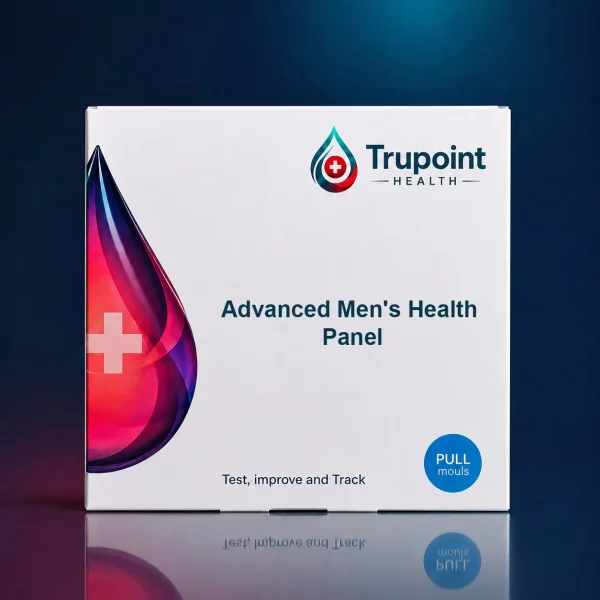
A 40-marker advanced men’s health panel extending the essentials with ApoB, Lp(a), HbA1c, full thyroid function, iron status, inflammation markers.
The Advanced Men’s Health Panel builds on the essential baseline with 40 markers across nine domains. It extends cardiovascular assessment with ApoB and Lp(a) — the two emerging lipid risk markers most predictive of future cardiac events but not included in standard NHS lipid panels. Metabolic health is assessed with HbA1c, fasting insulin, and uric acid. Full thyroid function (TSH, FT4, FT3) replaces the TSH-only screen. Iron status is assessed through serum iron, ferritin, transferrin saturation, and TIBC. Inflammation is measured via high-sensitivity CRP and homocysteine — a cardiovascular risk marker linked to B12 and folate metabolism.
Hormone assessment is expanded to include free testosterone, LH, FSH, oestradiol, and prolactin alongside total testosterone and SHBG — giving a complete pituitary-testicular-oestrogenic picture. PSA is retained. Vitamin D and active B12 round out the nutritional profile.
This panel is ideal for men over 40 managing or preventing cardiovascular disease, metabolic syndrome, or hormonal decline, and for anyone who wants to go beyond the standard and understand the full landscape of their health. Venous blood draw required; morning collection essential. GMC-physician reviewed within 5 to 7 working days.
Understand what each marker measures, why it matters, and what the science says — not just a list of numbers.
Complete haematological screen for anaemia, infection, clotting, and haematological conditions.
Comprehensive liver panel assessing hepatocyte integrity, biliary function, and synthetic capacity.
Renal filtration, nitrogen clearance, and gout risk assessment.
Standard lipid profile for cardiovascular risk stratification.
Counts every atherogenic particle directly; a more precise cardiovascular risk marker than LDL alone.
Genetically determined cardiovascular risk marker; elevated in 20% of the population and not modifiable by standard statins.
Amino acid elevated in B12/folate deficiency; an independent cardiovascular and thrombotic risk factor.
Ultra-sensitive inflammation marker reflecting vascular and systemic inflammatory burden.
Complete androgen bioavailability assessment.
Pituitary signals distinguishing primary from secondary testosterone deficiency.
Oestrogen produced from testosterone in men; essential for bone, cardiovascular, and sexual health.
Pituitary hormone that suppresses testosterone when elevated.
Chronic glycaemic burden and insulin resistance assessment.
Full thyroid axis assessment including conversion efficiency.
Complete iron status — storage, transport, and saturation — to assess both deficiency and excess.
Key nutritional and prostate screening markers for comprehensive men's health monitoring.
This panel is designed for adults who want a comprehensive, evidence-based picture of their metabolic health — not a GP referral panel.
Men over 40 wanting a thorough annual assessment beyond the standard health check
Those with cardiovascular risk factors wanting ApoB and Lp(a) data
Men managing testosterone decline or considering TRT
Those with metabolic syndrome or pre-diabetes wanting a full picture
ApoB and Lp(a) are not yet universally included in NHS cardiac risk algorithms, though they are increasingly recommended by cardiology guidelines. Lp(a) is largely genetically determined and does not change significantly with lifestyle modification; elevated Lp(a) identifies risk rather than a reversible target. Fasting insulin is a screening indicator rather than a formal insulin resistance diagnostic test. Free testosterone is calculated rather than directly measured. PSA should be interpreted age-specifically and not as a standalone cancer screening tool. This panel does not include thyroid antibodies, cortisol, ACTH, or adrenal markers. Please share significantly abnormal results with your GP promptly.
From order to physician-reviewed report in as little as three working days.
Three options designed to fit your schedule, location, and preference — all producing a laboratory-standard sample.
Adults 18+ in mainland UK. Not suitable if you have had a transfusion in the last 3 months.
Order anytime; kit dispatched within 24 hours Mon–Fri.
Allow 24–48 hours for sample transit on top of lab processing time.
Adults 18+ within 20 miles of a serviced city centre.
Mon–Sun, 06:00–20:00. Next-day booking typical.
Sample reaches the lab within 24 hours of collection.
Adults 16+ with photo ID. Paediatric draws by appointment at selected sites.
Mon–Fri, with Saturday hours at most metropolitan locations.
Samples processed same-day at the receiving clinic.
Every test is processed in a UKAS ISO 15189-accredited laboratory, overseen by GMC-registered physicians, and governed by UK GDPR. No overseas processing, no offshore data.
Follow these guidelines to ensure accurate, reproducible results. Most markers are sensitive to recent food, exercise, and sleep.
Can't find your answer? Our clinical support team is available Monday to Friday, 9am–5pm.
Contact supportApoB (apolipoprotein B) is a protein that coats every atherogenic lipoprotein particle — including LDL, VLDL, IDL, and Lp(a). When we measure LDL, we are estimating the cholesterol content of LDL particles, which can be misleading when particles are small and dense (a pattern common in metabolic syndrome). ApoB, by contrast, counts the actual number of atherogenic particles regardless of their cholesterol content. Multiple large-scale studies have shown that ApoB is more predictive of cardiovascular events than LDL, particularly in men with normal LDL but high particle number. The 2023 ESC guidelines now recommend ApoB as the preferred measure of atherogenic risk.
Lipoprotein(a) — Lp(a) — is a modified form of LDL with an additional protein (apolipoprotein(a)) attached. It is strongly determined by genetics, meaning lifestyle and diet changes make very little difference to its level. Approximately 20 to 25% of the population carry elevated Lp(a), which significantly increases the risk of heart attack, stroke, and aortic valve disease — independently of standard cholesterol levels. Currently there are no licenced medications that specifically lower Lp(a) in the UK (RNA therapies are in late-stage trials), but knowing your Lp(a) level guides the aggressiveness of other cardiovascular risk reduction: statin therapy to bring LDL as low as possible, blood pressure control, and lifestyle optimisation become even more important.
Homocysteine is an amino acid produced during methionine metabolism. Elevated homocysteine (hyperhomocysteinaemia) is associated with endothelial damage, increased thrombotic risk, and independent cardiovascular disease risk. High homocysteine often reflects deficiency in the B-vitamins required to metabolise it — particularly B12, folate, and B6. Unlike Lp(a), elevated homocysteine is usually treatable: supplementation with B12, folate, and B6 can reliably lower homocysteine levels, and there is evidence that this reduces cardiovascular event risk, particularly in those with documented deficiency.
Men produce oestradiol through the conversion of testosterone by aromatase enzymes, found primarily in fat tissue, liver, and bone. Oestradiol in men is essential for: maintaining bone density (low oestradiol in men causes osteoporosis as readily as in women); regulating libido and erectile function; protecting the cardiovascular system; and supporting healthy cognitive function. In men on TRT without monitoring, oestradiol can become elevated (causing gynaecomastia, water retention, and mood changes) or, if an aromatase inhibitor is used aggressively, become too low (causing joint pain, poor bone density, and low libido despite adequate testosterone).
Ferritin reflects iron stores, but can be misleadingly elevated in inflammation (as an acute-phase protein) even when true iron stores are low. Including serum iron, transferrin saturation, and TIBC (total iron-binding capacity) gives a more complete and reliable iron status picture. Low serum iron with low transferrin saturation and high TIBC indicates true iron deficiency. Low serum iron with normal or elevated ferritin suggests iron sequestration due to chronic inflammation. For men — who are less commonly deficient than women but can develop iron overload (haemochromatosis) or iron deficiency from gastrointestinal causes — this fuller iron status picture is clinically important.
Ideally at 35 or earlier if there is a strong family history of premature cardiovascular disease (heart attack before 60 in a first-degree relative, or familial hypercholesterolaemia). Lp(a) only needs to be measured once in most individuals since it is genetically determined and does not change significantly over time. ApoB is useful to monitor in parallel with LDL, particularly if LDL appears controlled but cardiovascular risk remains unexplained. For men with no significant risk factors, a first ApoB and Lp(a) measurement by 40 is a reasonable baseline to establish cardiovascular risk before any primary prevention decisions are made.