
Discreet, accurate, and GMC-reviewed. Four of the most important STIs screened from a single home collection kit.
or 4 interest-free payments of £19.75 with Klarna
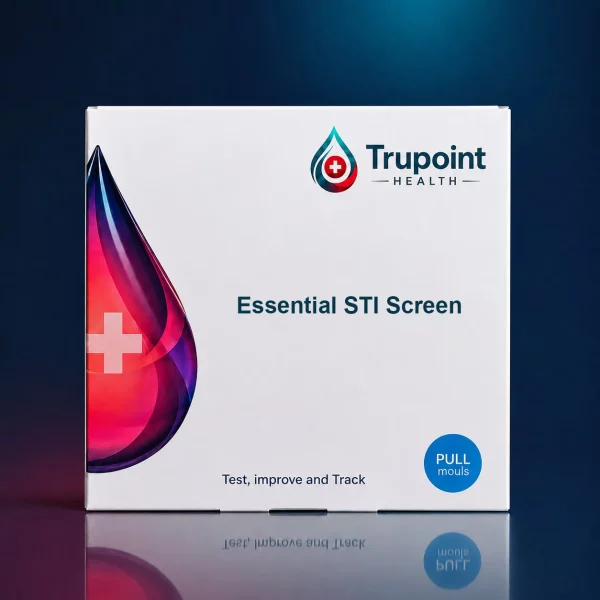
A four-pathogen sexual health screen covering HIV, syphilis, chlamydia, and gonorrhoea. Discreet home sample collection. GMC physician review.
Regular sexual health screening is a normal, responsible part of managing your health — especially following a new partner, unprotected sex, or any change in sexual behaviour. This four-pathogen screen covers the most commonly encountered sexually transmitted infections in the UK: HIV (with our fourth-generation antigen-antibody combination test, detecting infection from 45 days post-exposure), syphilis (RPR and TPHA serology), chlamydia (NAAT from a urine or swab sample), and gonorrhoea (NAAT). All testing is conducted at a UKAS ISO 15189-accredited laboratory. Your samples are handled with complete discretion, and results are delivered securely to your online dashboard. A GMC-registered physician reviews every result and provides clear guidance on treatment pathways where necessary. Early detection of any of these infections significantly improves treatment outcomes and reduces transmission.
Understand what each marker measures, why it matters, and what the science says — not just a list of numbers.
This panel is designed for adults who want a comprehensive, evidence-based picture of their metabolic health — not a GP referral panel.
Anyone with a new sexual partner or after unprotected sex
Men who have sex with men (MSM) — recommended at least every 3 months
Women planning a pregnancy who want to confirm their sexual health status
People returning from regions with higher STI prevalence
Anyone who simply wants the reassurance of a regular sexual health check
All STI tests have a window period — the time between infection and when the test can reliably detect it. For HIV, our fourth-generation test has a 45-day window period from the moment of potential exposure. Syphilis serology has a window of approximately 3 to 6 weeks. Chlamydia and gonorrhoea NAAT have a shorter window of approximately 1 to 2 weeks. Testing before the window period has elapsed may produce a false negative result. If you are within the window period for any pathogen, retesting after the full window has passed is recommended. This panel does not test for herpes simplex virus, HPV, hepatitis B, hepatitis C, Mycoplasma genitalium, trichomonas, or other STIs — see our comprehensive screens for these.
From order to physician-reviewed report in as little as three working days.
Discreet packaging. No identifying information on the outer envelope.
Urine sample and/or swabs as directed. Full instructions included.
Pre-paid Royal Mail envelope; same-day despatch recommended.
Online dashboard, password-protected. Results in 3 to 5 working days.
Three options designed to fit your schedule, location, and preference — all producing a laboratory-standard sample.
Adults 18+ in mainland UK. Not suitable if you have had a transfusion in the last 3 months.
Order anytime; kit dispatched within 24 hours Mon–Fri.
Allow 24–48 hours for sample transit on top of lab processing time.
Adults 18+ within 20 miles of a serviced city centre.
Mon–Sun, 06:00–20:00. Next-day booking typical.
Sample reaches the lab within 24 hours of collection.
Adults 16+ with photo ID. Paediatric draws by appointment at selected sites.
Mon–Fri, with Saturday hours at most metropolitan locations.
Samples processed same-day at the receiving clinic.
Every test is processed in a UKAS ISO 15189-accredited laboratory, overseen by GMC-registered physicians, and governed by UK GDPR. No overseas processing, no offshore data.
Follow these guidelines to ensure accurate, reproducible results. Most markers are sensitive to recent food, exercise, and sleep.
Can't find your answer? Our clinical support team is available Monday to Friday, 9am–5pm.
Contact supportOur fourth-generation HIV test detects both the p24 antigen (present from approximately 2 weeks after infection) and HIV antibodies (developing from approximately 4 to 6 weeks). Testing after 45 days post-exposure captures greater than 99 percent of infections. Testing at 90 days post-exposure is considered definitively conclusive by most UK and international guidelines. A reactive result is confirmed by a repeat specialist test before a formal positive result is communicated. If you have had a potential high-risk exposure in the last 72 hours, do not wait for testing — call 111 for guidance on post-exposure prophylaxis (PEP), which must be started within 72 hours to be effective.
The window period is the time between infection with a sexually transmitted pathogen and the point at which a test can reliably detect that infection. During the window period, you may be infectious but your test result could be falsely negative. For HIV this is 45 days with our test; for chlamydia and gonorrhoea it is 1 to 2 weeks; for syphilis approximately 3 to 6 weeks. If you test within the window period and get a negative result, you should retest after the window has passed to be confident in your result. Our physician commentary will advise on retesting if your sample was collected within a potential window period.
Yes. Your sample and results are processed under your Trupoint Health account, which is password-protected and compliant with GDPR. The outer packaging bears no identifying brand name. Your results are not shared with your GP, NHS, or any third party without your explicit consent. The only exception is our physician’s duty of care obligation if a result indicated an immediate risk to life, which is not applicable for routine STI results. You can choose to share your results with your GP or sexual health clinic at your discretion.
A positive result for chlamydia, gonorrhoea, or syphilis will be flagged in your physician commentary with clear guidance on seeking treatment. All three are effectively treatable with appropriate antibiotics. Chlamydia and uncomplicated gonorrhoea are typically treated with a single antibiotic course from a GP or sexual health clinic. Syphilis requires penicillin-based treatment prescribed by a sexual health clinic. A reactive HIV result will be followed up by our physician with urgent guidance on confirmatory testing and referral to HIV care services, where highly effective antiretroviral treatment is available that allows people to live full and healthy lives.
Frequency depends on your sexual activity and risk profile. NHS guidance recommends that all sexually active adults test at least annually. Men who have sex with men (MSM) are recommended to test every 3 months. Individuals with multiple partners or those using condoms inconsistently should test after each new partner. Regular testing normalises sexual health care and means that any infection is caught and treated promptly, before transmission to others and before complications develop. There is no minimum interval for retesting if you have had a new potential exposure.
Yes — partner notification is an important and responsible step. If you test positive for a bacterial STI, your recent sexual partners should be informed so they can test and, if necessary, receive treatment before unknowingly passing the infection to others. Sexual health clinics can assist with anonymous partner notification on your behalf if you prefer not to contact partners directly. HIV-positive individuals are legally and ethically obligated to disclose to sexual partners; specialist HIV care teams provide comprehensive support for this process.