Conclusive from 45 days post-exposure. The same fourth-generation HIV test used in NHS clinics — available from home.
or 4 interest-free payments of £12.25 with Klarna
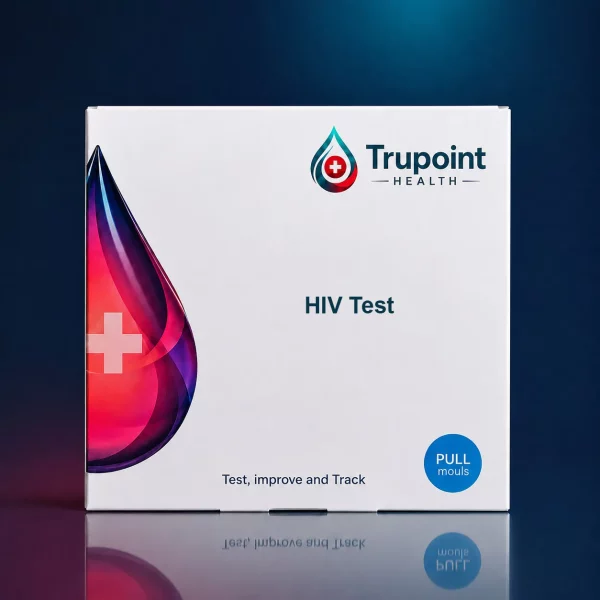
A fourth-generation HIV antigen-antibody combination test from a home fingerstick blood sample. Detects HIV from 45 days post-exposure. Discreet packaging.
Knowing your HIV status is fundamental to sexual health. Our fourth-generation HIV combination test detects both the p24 antigen (present from approximately two weeks after infection) and HIV antibodies (developing from approximately four to six weeks), giving a conclusive result from 45 days post-exposure. This is the same generation of test used in NHS and sexual health clinics. A positive result is confirmed by a repeat specialist test before being formally communicated. If you are within 72 hours of a high-risk exposure and have not yet tested, please call 111 immediately to access post-exposure prophylaxis (PEP) — do not wait to test. For confirmed HIV-positive individuals, this test is used for initial diagnosis only; ongoing monitoring requires viral load and CD4 count testing through NHS HIV care. All results are reviewed by a GMC-registered physician and communicated with clear, compassionate guidance.
Understand what each marker measures, why it matters, and what the science says — not just a list of numbers.
This panel is designed for adults who want a comprehensive, evidence-based picture of their metabolic health — not a GP referral panel.
Anyone who has had unprotected sex and wants to know their HIV status
People requesting a routine HIV screen as part of standard sexual health practice
MSM individuals following potential exposure
Healthcare workers or individuals with occupational exposure history
Individuals who have never been tested and want to establish a baseline
Our fourth-generation HIV test has a 45-day window period. Testing before 45 days post-exposure may produce a false negative result. For absolute certainty, a negative result at 45 days should be confirmed with a repeat test at 90 days post-exposure in line with UK and international guidance. This test does not detect HIV RNA directly (PCR); the absolute earliest window for HIV RNA is approximately 10 to 14 days post-exposure but this requires specialist laboratory testing not performed by routine dried blood spot. A reactive result on this test will be subject to confirmatory testing before a positive diagnosis is made.
From order to physician-reviewed report in as little as three working days.
Discreet packaging. No identifying markings on the outer envelope.
Testing before 45 days may not detect early infection.
Simple fingerstick blood spot. Pre-paid Royal Mail envelope included.
Secure online report with physician commentary in 3 to 5 working days.
Three options designed to fit your schedule, location, and preference — all producing a laboratory-standard sample.
Adults 18+ in mainland UK. Not suitable if you have had a transfusion in the last 3 months.
Order anytime; kit dispatched within 24 hours Mon–Fri.
Allow 24–48 hours for sample transit on top of lab processing time.
Adults 18+ within 20 miles of a serviced city centre.
Mon–Sun, 06:00–20:00. Next-day booking typical.
Sample reaches the lab within 24 hours of collection.
Adults 16+ with photo ID. Paediatric draws by appointment at selected sites.
Mon–Fri, with Saturday hours at most metropolitan locations.
Samples processed same-day at the receiving clinic.
Every test is processed in a UKAS ISO 15189-accredited laboratory, overseen by GMC-registered physicians, and governed by UK GDPR. No overseas processing, no offshore data.
Follow these guidelines to ensure accurate, reproducible results. Most markers are sensitive to recent food, exercise, and sleep.
Can't find your answer? Our clinical support team is available Monday to Friday, 9am–5pm.
Contact supportThird-generation HIV tests detect only HIV antibodies, which take 4 to 6 weeks to develop in most individuals but up to 12 weeks in some, creating a longer window of potential false negatives. Fourth-generation combination tests add detection of the HIV p24 antigen, which appears in the blood approximately 2 weeks after infection — before antibodies develop. This combination substantially narrows the window period: a fourth-generation test at 45 days post-exposure is greater than 99 percent sensitive for HIV. This is why fourth-generation tests are now the recommended standard across the NHS and most international guidelines.
A reactive result on our screening test will be accompanied by physician guidance to attend a sexual health clinic or genitourinary medicine (GUM) clinic as soon as possible for confirmatory testing. A reactive screening result does not constitute a confirmed HIV diagnosis; a second confirmatory test using a different method (typically a Western blot or alternative immunoassay) is required. If the confirmatory test is also positive, you will be referred into HIV care. Modern antiretroviral therapy (ART) allows people living with HIV to achieve an undetectable viral load, meaning they cannot transmit the virus sexually and can expect a near-normal life expectancy.
Post-exposure prophylaxis (PEP) is a short course (28 days) of antiretroviral medication that can prevent HIV infection if started within 72 hours of a high-risk exposure. The sooner PEP is started after exposure, the more effective it is; it should ideally be started within 24 hours. PEP is available free through NHS sexual health clinics, A&E departments, and GUM clinics. If you believe you have had a potential high-risk HIV exposure within the last 72 hours, do not order a home test — call 111 or go directly to an A&E department or sexual health clinic and ask for a PEP assessment.
Pre-exposure prophylaxis (PrEP) is a daily antiretroviral medication (tenofovir/emtricitabine) taken by HIV-negative individuals at ongoing high risk of HIV infection. When taken consistently, PrEP reduces the risk of acquiring HIV from sexual contact by greater than 99 percent. PrEP is available free through NHS sexual health services in England and Scotland for eligible individuals. It is recommended for MSM with multiple partners, individuals in serodiscordant relationships (where one partner is HIV-positive), and others assessed as high risk. A regular HIV test is required before and during PrEP use.
A negative HIV result confirms your status at the time of testing (45 days post-exposure or later), not indefinitely. If you continue to have sexual contact with new or untested partners, you remain at potential risk of future HIV acquisition. Condoms remain one of the most effective protection methods against HIV and other STIs. The decision to reduce condom use in a relationship is a personal one that should be made with full awareness of both partners’ tested status and ongoing exposure risks. If you have ongoing higher-risk exposure, regular testing and consideration of PrEP are the recommended strategies.