Most people with herpes have never had a noticeable outbreak. A type-specific blood test tells you your status with certainty.
or 4 interest-free payments of £12.25 with Klarna
Type-specific IgG serology distinguishing HSV-1 from HSV-2. A blood-based test for past HSV exposure, including asymptomatic infection. Home fingerstick kit.
Herpes simplex virus affects a substantial proportion of the UK adult population. HSV-1 — traditionally associated with oral herpes (cold sores) — is estimated to be present in around 70 percent of adults. HSV-2, the primary cause of genital herpes, affects approximately 10 to 15 percent of adults in the UK. Many people infected with both types have never had a recognisable outbreak, meaning they are unaware of their status. This type-specific IgG serology test distinguishes HSV-1 from HSV-2 by detecting the specific antibodies produced against each strain. It provides information about past exposure, not current outbreak activity. A positive result does not indicate whether you are currently contagious, as the virus establishes a lifelong latent infection with intermittent shedding. The physician commentary provides clear guidance on disclosure strategies, antiviral suppressive therapy options, and risk reduction for both positive and negative results.
Understand what each marker measures, why it matters, and what the science says — not just a list of numbers.
This panel is designed for adults who want a comprehensive, evidence-based picture of their metabolic health — not a GP referral panel.
Anyone wanting to know their herpes status, particularly before a new relationship
Individuals with a partner known to have genital herpes (HSV-2)
People who experience recurrent symptoms (tingling, sores) that might be herpes outbreaks
Pregnant women or those planning pregnancy (neonatal herpes risk assessment)
Those who have never had a recognisable outbreak but want confirmation of their serological status
HSV IgG serology detects antibodies reflecting past infection, not current active outbreak or transmissibility. A positive IgG does not indicate whether you are currently shedding the virus. HSV-2 IgG has lower specificity than HSV-1 IgG, with some false positive results at low index values (index 1.1 to 3.5); equivocal results should be confirmed by a specialist laboratory. Serology cannot distinguish genital from oral infection; a positive HSV-1 could reflect oral cold sores or genital HSV-1 acquired through oral-genital contact. Serology requires 12 to 16 weeks after primary infection to become reliably positive; testing within this window may produce a false negative. PCR swab from an active lesion remains the most sensitive and specific test for confirming active herpes infection.
From order to physician-reviewed report in as little as three working days.
Discreet home fingerstick kit.
Earlier testing may produce a false negative.
Pre-paid Royal Mail envelope included.
Physician commentary with clear next steps in 3 to 5 working days.
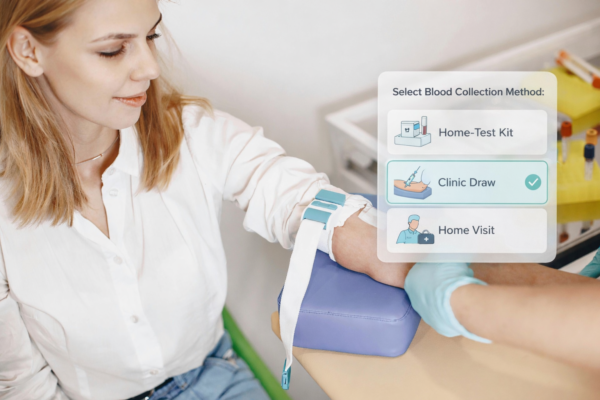
Three options designed to fit your schedule, location, and preference — all producing a laboratory-standard sample.
Adults 18+ in mainland UK. Not suitable if you have had a transfusion in the last 3 months.
Order anytime; kit dispatched within 24 hours Mon–Fri.
Allow 24–48 hours for sample transit on top of lab processing time.
Adults 18+ within 20 miles of a serviced city centre.
Mon–Sun, 06:00–20:00. Next-day booking typical.
Sample reaches the lab within 24 hours of collection.
Adults 16+ with photo ID. Paediatric draws by appointment at selected sites.
Mon–Fri, with Saturday hours at most metropolitan locations.
Samples processed same-day at the receiving clinic.
Every test is processed in a UKAS ISO 15189-accredited laboratory, overseen by GMC-registered physicians, and governed by UK GDPR. No overseas processing, no offshore data.
Follow these guidelines to ensure accurate, reproducible results. Most markers are sensitive to recent food, exercise, and sleep.
Can't find your answer? Our clinical support team is available Monday to Friday, 9am–5pm.
Contact supportA positive HSV-2 result means you have been infected with genital herpes and carry the virus for life, as it establishes a latent infection in sacral nerve ganglia. However, this does not mean your sex life is over or fundamentally altered. The virus sheds asymptomatically on a minority of days and the risk of transmission to an uninfected partner over the course of a year without suppressive therapy is approximately 4 to 10 percent. Daily suppressive antiviral therapy (aciclovir or valaciclovir) reduces shedding by approximately 50 percent and symptomatic outbreaks by approximately 70 to 80 percent. Consistent condom use further reduces transmission risk.
HSV-1 and HSV-2 are two closely related but distinct herpes simplex viruses. HSV-1 traditionally infects the oral area (causing cold sores) and is acquired, often in childhood, through non-sexual contact. HSV-2 primarily infects the genital area and is transmitted sexually. However, the distinction has become less clear: HSV-1 increasingly causes genital herpes due to oral-genital sexual contact, and HSV-1 genital infection typically causes fewer and less severe recurrences than HSV-2 genital infection. The type-specific test tells you which strain(s) you carry, which informs prognosis, recurrence frequency, and transmission risk discussions.
Yes. Asymptomatic viral shedding occurs in HSV-2 positive individuals on approximately 15 to 25 percent of days without any prodrome or visible lesion. This asymptomatic shedding is responsible for the majority of sexual transmission events, precisely because neither partner is aware it is occurring. This is why serology testing matters: knowing your status allows you to make informed decisions about disclosure, antiviral suppression, and condom use, even in the absence of recognisable outbreaks.
Ethical and practical considerations both support disclosure. Legally, while there is no specific UK law requiring disclosure of herpes, courts have found individuals liable for transmission without disclosure in some circumstances. Practically, disclosure allows a partner to make an informed choice about risk, to consider suppressive therapy in their infected partner, and to seek testing themselves. Many people who disclose find partners are accepting, particularly once informed about the actual transmission risk and available risk-reduction measures. Your physician commentary includes guidance and resources on disclosure conversations.
For people who experience frequent symptomatic outbreaks (more than six per year), daily suppressive therapy with aciclovir (400 mg twice daily) or valaciclovir (500 mg once daily) is clearly beneficial: it reduces outbreak frequency by approximately 70 to 80 percent, reduces the severity and duration of breakthrough outbreaks, and reduces asymptomatic shedding by approximately 50 percent, thereby reducing transmission risk to partners. For people with infrequent or mild outbreaks, episodic therapy (taken at the first sign of a prodrome) is a reasonable alternative. Discuss the most appropriate approach with your GP or a sexual health specialist.