
Ten-marker advanced cardiovascular panel — full lipid profile plus ApoB, Lp(a), homocysteine, and HbA1c.
or 4 interest-free payments of £22.25 with Klarna
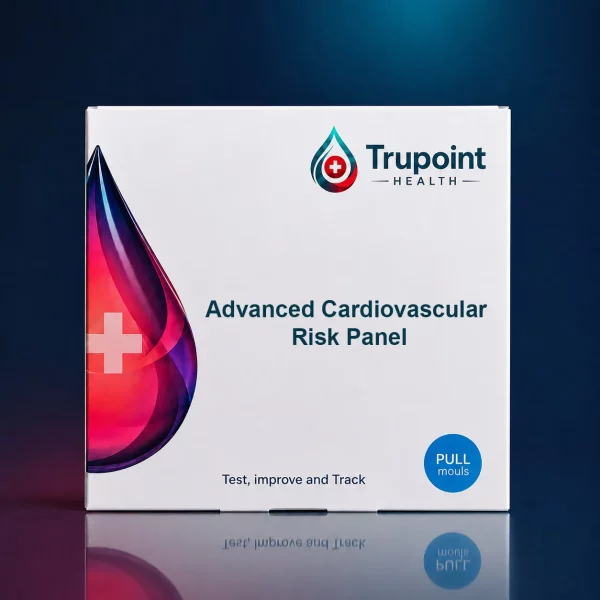
A ten-marker advanced cardiovascular risk panel adding ApoB, Lp(a), homocysteine, and HbA1c to the full lipid profile.
Standard cholesterol panels miss the patients most at risk. Approximately 20% of people who suffer heart attacks have normal LDL cholesterol — but many of them have elevated ApoB, elevated Lp(a), elevated homocysteine, or developing insulin resistance detectable by HbA1c.
The Advanced Cardiovascular Risk Panel builds on the standard lipid profile with four additional markers:
ApoB (apolipoprotein B): counts every atherogenic particle directly, catching the small dense LDL pattern that standard LDL misses in people with metabolic syndrome.
Lp(a) (lipoprotein(a)): a genetically elevated cardiovascular risk factor present in 1 in 5 people that is not lowered by standard statins. You only need to test it once — it barely changes with lifestyle.
Homocysteine: an independent thrombotic and cardiovascular risk marker that responds to B12 and folate supplementation.
HbA1c: identifies insulin resistance and pre-diabetes, which significantly amplify cardiovascular risk even at apparently normal cholesterol levels.
Home fingerstick kit available; fasted collection required. GMC-physician reviewed results within 3 to 5 working days.
Understand what each marker measures, why it matters, and what the science says — not just a list of numbers.
Core lipid panel for baseline cardiovascular risk assessment.
Direct particle count of all atherogenic lipoproteins; more predictive of cardiovascular events than LDL cholesterol content.
Genetically elevated in 20% of the population; substantially increases heart attack and stroke risk independently of other lipids.
Vascular inflammation marker; elevated hsCRP predicts cardiovascular events independently of cholesterol.
B12 and folate-sensitive amino acid; elevated homocysteine is an independent thrombotic and cardiovascular risk factor.
Three-month glycaemic average; pre-diabetes significantly amplifies cardiovascular risk even when cholesterol appears normal.
This panel is designed for adults who want a comprehensive, evidence-based picture of their metabolic health — not a GP referral panel.
Those with normal LDL but persistent cardiovascular symptoms or family history
People wanting the most complete cardiovascular blood risk picture available
Those over 40 who have never measured ApoB or Lp(a)
Individuals managing multiple cardiovascular risk factors wanting a comprehensive assessment
This panel provides the most comprehensive blood-based cardiovascular risk assessment available without dynamic or imaging testing, but does not include coronary calcium scoring, carotid IMT measurement, or other imaging-based risk stratification tools. Lp(a) is genetically determined and changes very little with lifestyle interventions. HbA1c is not a diagnostic test for diabetes; formal diagnosis requires repeat testing or an oral glucose tolerance test. Elevated homocysteine requires clinical interpretation to distinguish cardiovascular risk from underlying B12/folate deficiency or kidney disease. hsCRP elevation during or after acute illness may not reflect vascular risk; retest once recovered.
From order to physician-reviewed report in as little as three working days.
Three options designed to fit your schedule, location, and preference — all producing a laboratory-standard sample.
Adults 18+ in mainland UK. Not suitable if you have had a transfusion in the last 3 months.
Order anytime; kit dispatched within 24 hours Mon–Fri.
Allow 24–48 hours for sample transit on top of lab processing time.
Adults 18+ within 20 miles of a serviced city centre.
Mon–Sun, 06:00–20:00. Next-day booking typical.
Sample reaches the lab within 24 hours of collection.
Adults 16+ with photo ID. Paediatric draws by appointment at selected sites.
Mon–Fri, with Saturday hours at most metropolitan locations.
Samples processed same-day at the receiving clinic.
Every test is processed in a UKAS ISO 15189-accredited laboratory, overseen by GMC-registered physicians, and governed by UK GDPR. No overseas processing, no offshore data.
Follow these guidelines to ensure accurate, reproducible results. Most markers are sensitive to recent food, exercise, and sleep.
Can't find your answer? Our clinical support team is available Monday to Friday, 9am–5pm.
Contact supportKnowing your Lp(a) level changes clinical management even though Lp(a) itself is not readily modifiable. If your Lp(a) is elevated, it means your cardiovascular risk is significantly higher than your standard lipid panel suggests — and therefore the thresholds for starting statin therapy, achieving a lower LDL target, and managing other risk factors more aggressively are all shifted. Cardiologists in the UK and internationally increasingly recommend treating Lp(a) as a ‘multiplier’ of standard risk: it tells you to treat your other risk factors harder. Emerging RNA therapies specifically targeting Lp(a) are in late clinical trials and may become available within the next few years.
The European Atherosclerosis Society recommends considering Lp(a) above 50 mg/dL (approximately 107 nmol/L) as elevated and a significant cardiovascular risk factor. Very high levels (above 180 mg/dL) carry a risk equivalent to heterozygous familial hypercholesterolaemia. Because Lp(a) is genetically determined, it only needs to be measured once in most individuals unless clinical context changes. Interestingly, South Asian, African, and African-Caribbean individuals tend to have higher Lp(a) levels on average than European individuals — population-specific context matters.
Elevated homocysteine is thought to damage the endothelium (the inner lining of blood vessels) through oxidative stress and direct cytotoxic effects, promoting inflammation, platelet aggregation, and arterial stiffness. It is also associated with increased thrombotic risk (blood clot formation). The accumulation of homocysteine in the blood occurs when the B-vitamin-dependent pathway that converts it to methionine or cysteine is impaired — either due to B12, folate, or B6 deficiency, or genetic variants in the MTHFR enzyme. Correcting deficiency through B-vitamin supplementation reliably lowers homocysteine levels.
Yes. Pre-diabetes (HbA1c 42 to 47 mmol/mol) is associated with significantly elevated cardiovascular risk — independent of standard lipid levels, blood pressure, and obesity. This is because elevated blood glucose promotes endothelial dysfunction, oxidative stress, inflammation, and accelerated atherosclerosis, even at pre-diabetic levels. Including HbA1c in a cardiovascular risk assessment identifies people who are ‘normal’ by cholesterol alone but who are accruing cardiovascular risk through the metabolic channel. It also flags those who should receive early lifestyle or pharmacological intervention to prevent progression to type 2 diabetes.
The most effective way to reduce ApoB is to reduce LDL cholesterol, since each LDL particle carries one ApoB molecule. However, the same LDL reduction produces a greater relative reduction in ApoB in people with smaller, denser LDL particles (who have more particles per unit of LDL cholesterol). This means that in people with metabolic syndrome, weight loss and dietary changes that specifically reduce small dense LDL produce disproportionate improvements in ApoB relative to measured LDL cholesterol. PCSK9 inhibitors, which lower LDL by 50 to 60%, produce equivalent reductions in ApoB and are the most powerful tools currently available for ApoB reduction alongside statins.
Ideally at 35 for most adults, or earlier for those with a strong family history of premature cardiovascular disease (heart attack before 60 in a first-degree relative) or familial hypercholesterolaemia. Lp(a) testing once establishes your baseline genetic risk level. ApoB should be measured alongside LDL as part of comprehensive cardiovascular risk assessment, particularly if you have metabolic syndrome, diabetes, or other risk factors. Younger adults with concerning family histories may benefit from testing even earlier — knowing your cardiovascular risk profile at 30 gives you decades of opportunity to modify other risk factors.