Four-marker androgen panel for women — total and free testosterone, dehydroepiandrosterone sulphate (DHEA-S), and SHBG — to assess androgen balance and bioavailability.
or 4 interest-free payments of £22.25 with Klarna
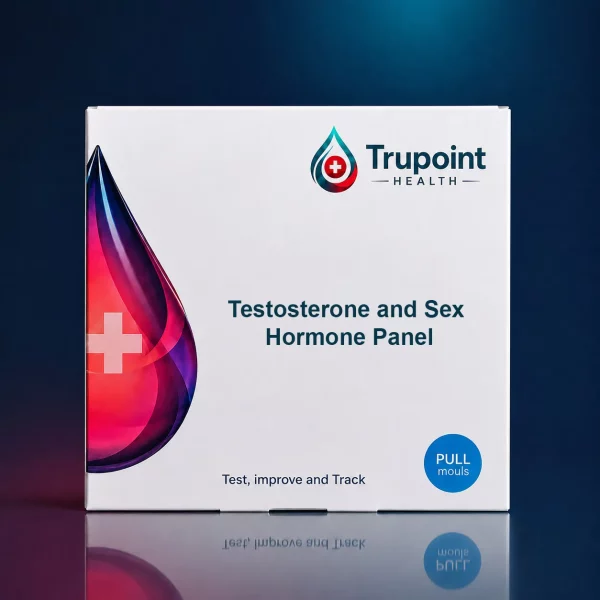
A four-marker androgen panel for women measuring total testosterone, free testosterone, SHBG, and dehydroepiandrosterone sulphate (DHEA-S).
Testosterone is not just a male hormone. In women, it is produced by the ovaries and adrenal glands and plays a vital role in libido, energy, mood, muscle strength, cognitive function, and bone density. Both too much and too little testosterone produce significant symptoms — yet it is rarely measured as part of standard hormonal assessments.
The Testosterone and Sex Hormone Panel measures total testosterone, free testosterone (calculated from SHBG), DHEAS (the adrenal precursor to testosterone), and SHBG (the binding protein that controls testosterone’s bioavailability). Together these four markers provide a complete picture of androgen activity in women — distinguishing between ovarian and adrenal androgen sources and identifying whether symptoms are driven by absolute testosterone changes or by SHBG-mediated changes in bioavailable testosterone.
This panel is relevant for women with reduced libido (particularly on the oral contraceptive pill, which raises SHBG dramatically), those experiencing unexplained fatigue and muscle weakness, women with acne or excess hair growth, and those in perimenopause or post-menopause. Venous draw required. GMC-physician reviewed results within 3 to 5 working days.
Understand what each marker measures, why it matters, and what the science says — not just a list of numbers.
Total circulating testosterone; in women, it reflects combined ovarian and adrenal output and influences libido, energy, and muscle function.
Biologically active fraction not bound to SHBG; often more clinically relevant than total testosterone for symptom-level assessment.
Adrenal androgen precursor; distinguishes adrenal from ovarian androgen excess and reflects adrenal androgen reserve.
Carrier protein for testosterone and oestradiol; low SHBG increases free androgen activity, high SHBG (e.g. from oral contraceptives) reduces it.
This panel is designed for adults who want a comprehensive, evidence-based picture of their metabolic health — not a GP referral panel.
Women experiencing reduced libido, particularly while on or after stopping the pill
Those with fatigue, low motivation, or difficulty maintaining muscle mass
Women with acne, excess facial or body hair, or scalp hair thinning
Perimenopausal and post-menopausal women exploring testosterone replacement options
Testosterone in women is measured at very low concentrations and requires a highly sensitive laboratory assay for accurate results. Standard testosterone assays designed for male ranges can be inaccurate at female reference levels; Trupoint Health's UKAS-accredited laboratory uses LC-MS/MS methodology appropriate for female range measurement. Free testosterone is calculated from total testosterone and SHBG rather than directly measured. A single result is a snapshot; testosterone can fluctuate throughout the cycle. This panel does not include oestradiol, progesterone, LH, or FSH, which may be needed for a complete hormonal picture. Do not commence testosterone supplementation based solely on this result without medical assessment.
From order to physician-reviewed report in as little as three working days.
Three options designed to fit your schedule, location, and preference — all producing a laboratory-standard sample.
Adults 18+ in mainland UK. Not suitable if you have had a transfusion in the last 3 months.
Order anytime; kit dispatched within 24 hours Mon–Fri.
Allow 24–48 hours for sample transit on top of lab processing time.
Adults 18+ within 20 miles of a serviced city centre.
Mon–Sun, 06:00–20:00. Next-day booking typical.
Sample reaches the lab within 24 hours of collection.
Adults 16+ with photo ID. Paediatric draws by appointment at selected sites.
Mon–Fri, with Saturday hours at most metropolitan locations.
Samples processed same-day at the receiving clinic.
Every test is processed in a UKAS ISO 15189-accredited laboratory, overseen by GMC-registered physicians, and governed by UK GDPR. No overseas processing, no offshore data.
Follow these guidelines to ensure accurate, reproducible results. Most markers are sensitive to recent food, exercise, and sleep.
Can't find your answer? Our clinical support team is available Monday to Friday, 9am–5pm.
Contact supportYes, particularly after the age of 40 and during or after menopause, when ovarian androgen production declines along with oestrogen. However, low testosterone can also affect younger women — particularly those on the combined oral contraceptive pill, which dramatically raises SHBG and reduces free testosterone, sometimes by 50% or more. Women who have had their ovaries removed surgically (bilateral oophorectomy) experience a sudden and dramatic drop in testosterone that often causes significant symptoms. Despite this, routine testosterone testing for women is rarely offered in NHS primary care.
Common symptoms of low testosterone (or low free testosterone) in women include: significantly reduced or absent libido; persistent fatigue and low motivation that are not explained by sleep or other factors; difficulty maintaining muscle mass despite exercise; low mood, reduced sense of wellbeing, and a flattened emotional responsiveness sometimes described as ‘feeling nothing’; poor concentration and cognitive changes. These symptoms overlap with hypothyroidism, depression, and iron deficiency, which is why testing is valuable for distinguishing between them.
Yes. Testosterone replacement therapy is available for women in the UK on prescription. Testogel (a testosterone gel) has received regulatory approval for use in women with hypoactive sexual desire disorder (HSDD) due to menopause. Some specialist clinicians also prescribe testosterone for pre-menopausal women with confirmed deficiency and significant symptoms. Evidence supports its benefit for libido, energy, and mood in deficient women. Prescribing decisions require a qualified clinician, and this panel provides the objective baseline data that makes those conversations evidence-based.
The combined oral contraceptive pill (COC) suppresses ovarian androgen production and significantly raises SHBG — sometimes by 3 to 4 times. The net effect is a dramatic reduction in free testosterone, which persists for months to years after stopping the pill in some women (a phenomenon sometimes called ‘post-pill androgen deficiency’). Women who experience persistent low libido or fatigue after coming off the pill may have this as an underlying mechanism. This panel identifies whether low free testosterone (relative to SHBG) is the issue, independent of whether total testosterone appears numerically normal.
Elevated testosterone in women most commonly indicates polycystic ovary syndrome (PCOS), though it can also result from congenital adrenal hyperplasia (CAH), ovarian or adrenal tumours (rarely), or exogenous androgen use. The pattern of elevation — whether total testosterone, free testosterone, dehydroepiandrosterone sulphate (DHEA-S), or all three — helps direct the differential diagnosis. Elevated dehydroepiandrosterone sulphate (DHEA-S) alongside testosterone suggests an adrenal contribution. If total testosterone is significantly elevated (above 5 nmol/L in most women’s reference ranges), specialist investigation is warranted. Your physician report will provide guidance on appropriate next steps.
dehydroepiandrosterone sulphate (DHEA-S) is produced almost exclusively by the adrenal glands and serves as a precursor to testosterone and other sex hormones. Including dehydroepiandrosterone sulphate (DHEA-S) alongside testosterone allows the panel to distinguish between androgen excess of ovarian origin (elevated testosterone with normal dehydroepiandrosterone sulphate (DHEA-S) — more typical of PCOS) and adrenal origin (elevated dehydroepiandrosterone sulphate (DHEA-S) with or without elevated testosterone — more typical of late-onset congenital adrenal hyperplasia or, rarely, adrenal tumours). dehydroepiandrosterone sulphate (DHEA-S) also reflects adrenal reserve and declines with age; low dehydroepiandrosterone sulphate (DHEA-S) in a fatigued woman may contribute to the clinical picture independently of testosterone status.