
Ten pathogens. Complete reassurance. The most thorough STI screen we offer — built for peace of mind and new-relationship confidence.
or 4 interest-free payments of £37.25 with Klarna
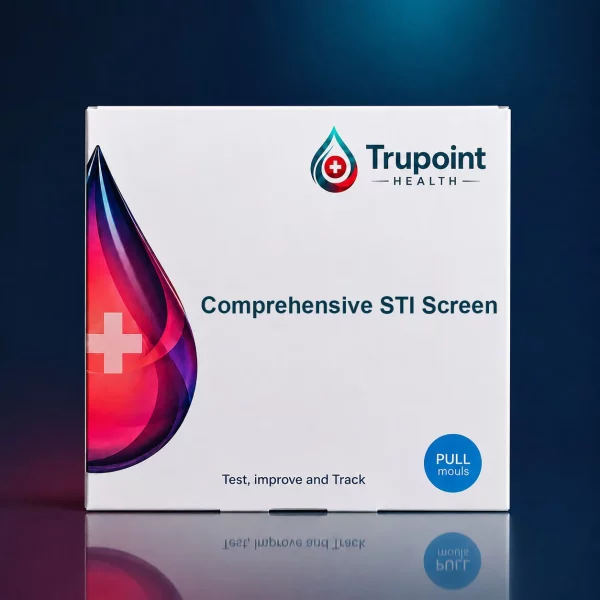
A ten-pathogen sexual health screen covering HIV, syphilis, chlamydia, gonorrhoea, herpes simplex 1 and 2, hepatitis B and C, Mycoplasma genitalium.
For a complete picture of your sexual health, this comprehensive ten-pathogen panel leaves nothing unexamined. In addition to the core four (HIV, syphilis, chlamydia, gonorrhoea), it adds herpes simplex virus type 1 and type 2 antibody testing, hepatitis B surface antigen and core antibody screening, hepatitis C antibody, Mycoplasma genitalium (an increasingly antibiotic-resistant bacterial STI often missed on standard screens), and trichomonas vaginalis. This panel is designed for people who want complete reassurance, those with higher-risk exposure histories, or individuals entering a new long-term relationship and wanting a definitive starting-point screen. All testing is performed at a UKAS ISO 15189-accredited laboratory. Results include full GMC-registered physician commentary with clear treatment pathway guidance for any positive or reactive findings.
Understand what each marker measures, why it matters, and what the science says — not just a list of numbers.
This panel is designed for adults who want a comprehensive, evidence-based picture of their metabolic health — not a GP referral panel.
Anyone wanting complete sexual health reassurance before or within a new relationship
MSM individuals following higher-risk exposure
People with multiple partners who test regularly as a health habit
Those with a history of pelvic inflammatory disease wanting a definitive screen
Individuals who have lived or travelled in regions with higher STI prevalence
This panel does not include HPV typing, which requires a physical cervical or throat swab processed at a specialist virology laboratory. Herpes simplex serology detects antibodies reflecting past infection and cannot distinguish a current active outbreak from past resolved infection or asymptomatic shedding; a positive HSV-2 IgG confirms lifetime exposure to genital herpes but does not indicate whether you are currently contagious. Mycoplasma genitalium NAAT has high sensitivity, but resistance testing is not routinely included; if Mycoplasma is detected, specialist sexual health guidance on macrolide-sparing treatment is essential due to widespread azithromycin resistance. All window period limitations applicable to the Essential STI Screen also apply here.
From order to physician-reviewed report in as little as three working days.
Comprehensive home collection kit. Plain discreet packaging.
Full step-by-step instructions included for each sample type.
Pre-paid Royal Mail. Despatch on the day of collection.
Physician commentary for all 10 pathogens in 3 to 5 working days.
Three options designed to fit your schedule, location, and preference — all producing a laboratory-standard sample.
Adults 18+ in mainland UK. Not suitable if you have had a transfusion in the last 3 months.
Order anytime; kit dispatched within 24 hours Mon–Fri.
Allow 24–48 hours for sample transit on top of lab processing time.
Adults 18+ within 20 miles of a serviced city centre.
Mon–Sun, 06:00–20:00. Next-day booking typical.
Sample reaches the lab within 24 hours of collection.
Adults 16+ with photo ID. Paediatric draws by appointment at selected sites.
Mon–Fri, with Saturday hours at most metropolitan locations.
Samples processed same-day at the receiving clinic.
Every test is processed in a UKAS ISO 15189-accredited laboratory, overseen by GMC-registered physicians, and governed by UK GDPR. No overseas processing, no offshore data.
Follow these guidelines to ensure accurate, reproducible results. Most markers are sensitive to recent food, exercise, and sleep.
Can't find your answer? Our clinical support team is available Monday to Friday, 9am–5pm.
Contact supportMycoplasma genitalium is a small bacterial STI that is increasingly recognised as a significant cause of sexually transmitted infection but is not tested on standard NHS STI screens. It is associated with urethritis in men (causing discharge and discomfort) and with pelvic inflammatory disease, cervicitis, and preterm birth in women. It is often entirely asymptomatic. What makes Mycoplasma genitalium clinically important is its high rate of resistance to azithromycin, the antibiotic typically used to treat chlamydia and sometimes presumptively used for non-gonococcal urethritis. Standard chlamydia treatment can fail against Mycoplasma and may select for further resistance, which is why specific detection and resistance-informed treatment is essential.
Not necessarily. HSV IgG antibodies indicate past exposure to herpes simplex virus. Once infected, HSV establishes a lifelong latent infection in nerve ganglia, with periodic reactivation and viral shedding. A positive IgG means you have been infected at some point; it does not tell you whether you are currently experiencing an active outbreak or asymptomatically shedding the virus. Asymptomatic shedding does occur and represents the primary mode of sexual transmission to uninfected partners. If you have a positive HSV-2 result, your physician commentary will provide guidance on suppressive antiviral therapy, disclosure strategies, and risk reduction.
The hepatitis B core antibody (anti-HBc) test detects exposure to the hepatitis B virus core protein, which appears regardless of whether the infection was acute, chronic, or resolved. A positive anti-HBc with a negative surface antigen (HBsAg) typically indicates a past resolved hepatitis B infection. A positive HBsAg indicates current infection. Testing both together distinguishes active infection from resolved past infection and also from vaccine-induced immunity, which produces surface antibody (anti-HBs) but not core antibody. If you have been vaccinated against hepatitis B, your core antibody will be negative and surface antibody positive — a reassuring pattern.
No. Hepatitis A is transmitted primarily by the faecal-oral route rather than sexual contact, though it can be transmitted sexually through certain practices. Hepatitis A testing is not included in this panel; if you require hepatitis A screening, this can be arranged through your GP or a specialist travel clinic. Hepatitis A vaccination is available on the NHS for individuals in high-risk groups and is recommended before travel to many countries.
Yes, if you have been sexually active since your last test. A negative result reflects your status at the time of collection, not indefinitely. Many sexual health guidelines recommend testing every 3 months for individuals with multiple partners or higher-risk exposure patterns, and at least annually for all sexually active adults. Testing is a regular health habit rather than a one-off event, in the same way that blood pressure or dental checks are repeated periodically. Regular testing also allows the detection of antibiotic resistance patterns in recurrent bacterial infections.
Trichomonas vaginalis is a single-celled parasite transmitted through sexual contact with an infected person. It is the most common curable sexually transmitted infection globally, estimated to affect over 150 million people worldwide each year. The majority of infected individuals — particularly men — are asymptomatic, making it easy to pass on unknowingly. When symptoms do occur in women, they typically include an unpleasant-smelling, frothy yellow-green discharge, vaginal soreness and itching, and pain on urination. In men, symptoms are usually mild or absent but can include urethral discharge or discomfort. Trichomonas is readily treatable with a single dose of metronidazole, and sexual partners should be treated simultaneously.