Ten-marker panel for comprehensive menopausal hormone and health monitoring — sex hormones, adrenal, thyroid, and vitamin D.
or 4 interest-free payments of £32.25 with Klarna
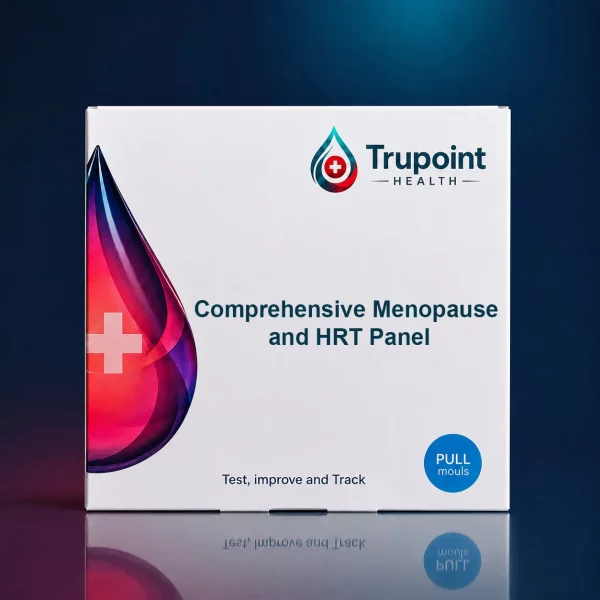
A ten-marker panel for peri- and post-menopausal women combining full sex hormones, adrenal assessment, thyroid function, and vitamin D.
Menopause affects every hormonal system in the body, not just oestrogen. The Comprehensive Menopause and HRT Panel recognises this complexity by measuring ten markers across four domains.
Sex hormones: FSH, LH, oestradiol, progesterone, total testosterone, and SHBG — giving a complete picture of the menopausal transition or post-menopausal hormone environment, including bioavailable testosterone for libido assessment.
Adrenal: dehydroepiandrosterone sulphate (DHEA-S) — the adrenal androgen precursor that serves as the main source of remaining sex hormone substrate in post-menopausal women, and which can be assessed as a contributing factor to energy, libido, and wellbeing.
Thyroid: TSH — because hypothyroidism is extremely common in peri- and post-menopausal women and mimics or worsens menopausal symptoms.
Nutritional: vitamin D — deficiency is prevalent in post-menopausal women and compounds the risks of bone loss, mood changes, and immune dysfunction that menopause itself creates.
This panel is used by women preparing to start HRT, monitoring HRT effectiveness, or seeking a comprehensive annual hormonal and health review. Venous draw required. GMC-physician reviewed within 5 to 7 working days.
Understand what each marker measures, why it matters, and what the science says — not just a list of numbers.
Pituitary signal elevated in menopause; suppressed by systemic oestrogen HRT.
Pituitary signal elevated post-menopause; contextualises FSH and ovarian response.
Primary oestrogen for symptom control and HRT dose assessment; target range varies by regimen.
Post-ovulation balancing hormone; relevant in perimenopause and in women on combined HRT.
Declines through menopause; assessed alongside SHBG for bioavailability in libido evaluation.
Carrier protein influencing free testosterone; raised by oral oestrogen HRT, neutral with transdermal.
Principal post-menopausal androgen precursor from adrenal glands; contributes to libido, energy, and wellbeing.
Screens for hypothyroidism, which is common in post-menopausal women and can mimic or amplify menopausal symptoms.
Bone, immune, and mood support; deficiency compounds the osteoporosis and mood risks of oestrogen decline.
This panel is designed for adults who want a comprehensive, evidence-based picture of their metabolic health — not a GP referral panel.
Women preparing to start HRT who want a comprehensive baseline
Those already on HRT who want to monitor effectiveness and safety markers
Peri- or post-menopausal women experiencing complex multi-symptom presentations
Those concerned about bone health, mood, and energy in addition to classic hot flushes
Hormone values in women on HRT must be interpreted in the context of the type, dose, and route of HRT. FSH and LH are unreliable menopausal status indicators when systemic oestrogen is taken. Oestradiol targets vary by treatment goal — symptom control versus endometrial protection requires different target ranges. dehydroepiandrosterone sulphate (DHEA-S) declines steadily with age regardless of menopausal status and must be interpreted using age-adjusted reference ranges. TSH alone does not assess full thyroid function; if thyroid symptoms are prominent, FT3 and FT4 should be added. Vitamin D management should be discussed with a GP, particularly regarding supplementation dosing for bone protection.
From order to physician-reviewed report in as little as three working days.
Three options designed to fit your schedule, location, and preference — all producing a laboratory-standard sample.
Adults 18+ in mainland UK. Not suitable if you have had a transfusion in the last 3 months.
Order anytime; kit dispatched within 24 hours Mon–Fri.
Allow 24–48 hours for sample transit on top of lab processing time.
Adults 18+ within 20 miles of a serviced city centre.
Mon–Sun, 06:00–20:00. Next-day booking typical.
Sample reaches the lab within 24 hours of collection.
Adults 16+ with photo ID. Paediatric draws by appointment at selected sites.
Mon–Fri, with Saturday hours at most metropolitan locations.
Samples processed same-day at the receiving clinic.
Every test is processed in a UKAS ISO 15189-accredited laboratory, overseen by GMC-registered physicians, and governed by UK GDPR. No overseas processing, no offshore data.
Follow these guidelines to ensure accurate, reproducible results. Most markers are sensitive to recent food, exercise, and sleep.
Can't find your answer? Our clinical support team is available Monday to Friday, 9am–5pm.
Contact supportThere is no single universal target oestradiol level for HRT users — it depends on symptoms, cardiovascular risk, bone protection goals, and individual physiology. For symptom control (hot flushes, night sweats), most women feel relief at oestradiol levels above 200 to 300 pmol/L. For bone protection, the threshold is generally above 100 pmol/L. For women on topical gel or spray, oestradiol is typically in the range of 200 to 600 pmol/L depending on dose. For oral oestrogen, values can be higher. Your physician report will interpret your oestradiol in the context of your HRT regimen and reported symptoms.
NICE guidance reflects that for women aged 45 and over with typical menopausal symptoms, the clinical diagnosis is sufficient to justify a trial of HRT — a blood test that confirms low oestradiol adds little to a decision already supported by symptoms and clinical assessment. However, blood tests remain valuable for: women under 45; those with atypical presentations; monitoring HRT effectiveness in women with persistent symptoms; assessing testosterone for libido; and identifying co-existing conditions (thyroid, vitamin D) that worsen menopausal symptoms. Blood tests do not replace the clinical consultation, but they add objective data to it.
After menopause, the ovaries produce very little oestrogen or testosterone. The adrenal glands become the primary source of androgen precursors — particularly dehydroepiandrosterone sulphate (DHEA-S) — which peripheral tissues convert into small amounts of oestrogens and androgens. dehydroepiandrosterone sulphate (DHEA-S) therefore becomes relatively more important in post-menopausal women for maintaining some baseline sex hormone activity, energy, and wellbeing. dehydroepiandrosterone sulphate (DHEA-S) also declines with age independently of menopause, so post-menopausal women can have very low dehydroepiandrosterone sulphate (DHEA-S). While dehydroepiandrosterone (DHEA) supplementation is used in some women, it requires careful clinical oversight and is not a DIY intervention.
It can provide objective data to inform that conversation. If your oestradiol is very low and you are still experiencing significant vasomotor symptoms (hot flushes, night sweats), an oestrogen dose increase may be appropriate. If testosterone is very low with low libido and adding testosterone therapy is being considered, this panel provides the baseline. If SHBG is very high (more common with oral oestrogen) and free testosterone is consequently very low, switching to transdermal oestrogen may improve androgen availability without adding testosterone separately. These discussions should happen with your prescribing physician.
Yes, and NICE recommends all adults in the UK take a vitamin D supplement (10 mcg / 400 IU daily) throughout autumn and winter. After menopause, oestrogen loss accelerates bone density reduction, and vitamin D is essential for calcium absorption — making deficiency correction even more important. Women with confirmed deficiency (25-OH vitamin D below 50 nmol/L) may require higher therapeutic doses (1,000 to 4,000 IU daily) under medical guidance. Monitoring annually ensures dosing remains appropriate as levels change with season, sun exposure, and supplementation.
This depends on your HRT regimen. Women taking combined HRT (oestrogen plus progestogen) — whether sequential or continuous — will have progesterone levels influenced by their regimen. Natural (bioidentical) progesterone (Utrogestan) produces measurable serum progesterone; synthetic progestogens (norethisterone, medroxyprogesterone) do not raise serum progesterone levels but act on progesterone receptors. Measuring serum progesterone is most meaningful for women using natural progesterone — it confirms absorption and circulating levels. For synthetic progestogen users, it adds less direct information. Your physician report will clarify the relevance to your specific regimen.