Six-marker panel for women in the menopausal transition — FSH, LH, oestradiol, progesterone, testosterone, and AMH.
or 4 interest-free payments of £27.25 with Klarna
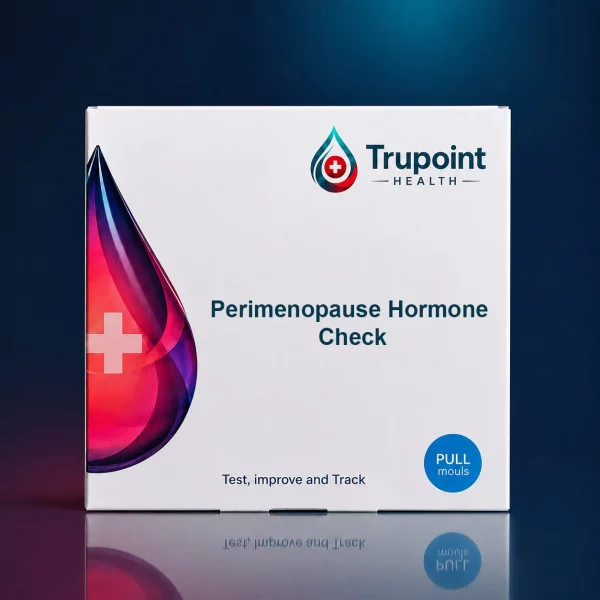
A six-marker hormone panel measuring FSH, LH, oestradiol, progesterone, testosterone, and AMH.
Perimenopause — the transitional phase leading to menopause — typically begins in the mid-40s but can start earlier. It is characterised by fluctuating and ultimately declining oestrogen and progesterone, rising FSH, and gradually depleting ovarian reserve. Symptoms can include irregular cycles, hot flushes, night sweats, mood changes, sleep disruption, reduced libido, and brain fog. Yet a single hormone test during perimenopause can be misleading because hormones fluctuate dramatically cycle to cycle.
The Perimenopause Hormone Check measures six markers that together give the most informative picture of where a woman is in the menopausal transition: FSH and LH (pituitary signals that rise as ovarian function declines), oestradiol and progesterone (ovarian outputs), testosterone (which also declines and affects libido and energy), and AMH (anti-Mullerian hormone — the most sensitive marker of remaining ovarian reserve).
This panel is a baseline and monitoring tool, not a single diagnostic test. Venous draw required; testing on days 2 to 5 of any available cycle is recommended. GMC-physician reviewed results within 5 to 7 working days.
Understand what each marker measures, why it matters, and what the science says — not just a list of numbers.
Rises progressively as ovarian reserve declines; a key marker of the menopausal transition stage and ovarian responsiveness.
Pituitary hormone governing ovulation; rises alongside FSH as the ovaries become less responsive.
Primary oestrogen; fluctuates significantly during perimenopause — can be transiently elevated before ultimately declining.
Post-ovulation hormone that declines as cycles become anovulatory; low progesterone relative to oestradiol drives many perimenopausal symptoms.
Declines in women during the menopausal transition, contributing to reduced libido, energy, and muscle tone.
Most sensitive marker of remaining ovarian follicle pool; declines steadily with age and is the earliest indicator of approaching menopause.
This panel is designed for adults who want a comprehensive, evidence-based picture of their metabolic health — not a GP referral panel.
Women aged 38 to 55 experiencing new or changing symptoms they suspect may be hormonal
Those with irregular cycles, sleep disruption, or unexplained mood changes
Women wanting to understand where they are in the menopausal transition
Those considering HRT who want a baseline hormone picture before discussing options with their GP
Perimenopause cannot be confirmed or excluded by a single blood test. Hormone levels fluctuate dramatically cycle to cycle during the transition, and a test taken during a period of relatively normal hormone levels may appear reassuringly normal even in a woman who is clearly perimenopausal on clinical grounds. FSH above 40 IU/L on two tests taken at least 4 to 6 weeks apart is required to confirm menopause in women under 50. AMH reflects ovarian reserve but cannot predict the timing of menopause with precision at the individual level. In the UK, NICE guidelines recommend that perimenopause is primarily a clinical diagnosis in women over 45 and does not require blood tests to initiate HRT. Please share results with your GP or a menopause specialist.
From order to physician-reviewed report in as little as three working days.
Three options designed to fit your schedule, location, and preference — all producing a laboratory-standard sample.
Adults 18+ in mainland UK. Not suitable if you have had a transfusion in the last 3 months.
Order anytime; kit dispatched within 24 hours Mon–Fri.
Allow 24–48 hours for sample transit on top of lab processing time.
Adults 18+ within 20 miles of a serviced city centre.
Mon–Sun, 06:00–20:00. Next-day booking typical.
Sample reaches the lab within 24 hours of collection.
Adults 16+ with photo ID. Paediatric draws by appointment at selected sites.
Mon–Fri, with Saturday hours at most metropolitan locations.
Samples processed same-day at the receiving clinic.
Every test is processed in a UKAS ISO 15189-accredited laboratory, overseen by GMC-registered physicians, and governed by UK GDPR. No overseas processing, no offshore data.
Follow these guidelines to ensure accurate, reproducible results. Most markers are sensitive to recent food, exercise, and sleep.
Can't find your answer? Our clinical support team is available Monday to Friday, 9am–5pm.
Contact supportA blood test can provide supporting evidence but cannot diagnose perimenopause on its own. In the UK, NICE guidelines state that for women over 45, perimenopause is a clinical diagnosis based on symptoms — a blood test is not required to start HRT. For women aged 40 to 45, blood tests can add useful information. For women under 40 with symptoms, testing is essential to exclude premature ovarian insufficiency (POI). This panel provides a hormonal snapshot that can be useful for establishing a baseline, understanding where you are in the transition, and informing discussions with your GP or menopause specialist.
In the UK, an FSH level above 30 IU/L is generally used as a supporting threshold for perimenopause, and FSH consistently above 40 IU/L on two tests at least 4 to 6 weeks apart is used to confirm menopause in women under 50. However, FSH fluctuates significantly during perimenopause — it can be elevated in one cycle and normal in the next. A normal FSH therefore does not exclude perimenopause, particularly if symptoms are present. AMH, which does not fluctuate with cycle timing, is a more stable marker of the remaining ovarian reserve.
AMH (anti-Mullerian hormone) is produced by the small growing follicles in the ovaries and reflects the size of the remaining follicle pool — the ovarian reserve. Unlike FSH, AMH can be measured at any point in the cycle and does not fluctuate significantly. It declines steadily with age and reaches very low or undetectable levels as menopause approaches. While AMH cannot predict the precise timing of menopause for an individual woman, very low AMH in a symptomatic woman in her 40s provides useful context for understanding the stage of the menopausal transition and for fertility planning.
Yes — counterintuitively, oestradiol can be elevated in early perimenopause. As the pituitary increases FSH output to drive remaining follicles, those follicles can sometimes produce more oestradiol than in a normal cycle. This erratic oestrogen output — swinging between high and low — is what drives many perimenopausal symptoms. A high oestradiol on a single test does not indicate the menopause is far away; it may simply reflect a surge-prone follicle. Serial testing or assessment alongside FSH and AMH gives a more complete picture.
Testosterone in women is produced by the ovaries and adrenal glands and declines gradually across the reproductive years — not sharply at menopause as oestrogen does. However, the decline becomes more noticeable in perimenopause and can contribute to reduced libido, fatigue, difficulty maintaining muscle mass, and diminished motivation and mood. Low testosterone in the context of perimenopausal symptoms is increasingly recognised as a clinical entity, and testosterone replacement (available in the UK on prescription, typically as Testogel) is a licenced option that some women find significantly beneficial.
This panel provides a useful baseline before starting HRT, allowing both you and your prescribing doctor to understand your hormone environment at the point of initiation. It also allows monitoring of how your natural hormone levels change over time during or after HRT use, though the interpretation of values while on HRT requires additional context (type and route of HRT used). Your physician report will provide guidance on interpreting results in your specific context. Trupoint Health results do not replace a consultation with a qualified clinician for HRT prescribing decisions, but they provide data that makes those conversations more informed.